FCI Reimagined as Real-Time with Willow

Facility Condition Index, or FCI, has long been our industry’s shorthand for understanding the health of buildings. At its core, FCI is a simple ratio: the cost of repairing an asset divided by the cost of replacing it. A higher number signals greater deterioration and greater capital risk. For decades, this metric has helped facilities teams communicate needs to leadership, justify budgets, and prioritize investments. Recalibrated in alignment with capital planning cycles, FCI is a static metric in an increasingly dynamic world, where operational demands shift constantly.
Challenges with Traditional FCI
Most organizations recalculate FCI every three to five years as part of a major condition assessment initiative. While this approach provides a useful snapshot in time, by definition, a point-in-time asset assessment can’t compare to the richness of continuous monitoring. A 24×7 signal can capture how assets actually perform over time, revealing trends, anomalies, and emerging risks. Further, a periodic assessment creates data latency in between capital planning cycles. Asset health scores available to decision makers may be based on inspections and replacement cost estimates collected years ago. During that time, assets continue to age and operating conditions change. A chiller that was assessed as healthy two years ago may now be nearing failure. A roof that showed minimal deterioration during the last inspection may have experienced significant degradation due to severe weather. Yet the FCI score often remains unchanged until the next assessment cycle.
Traditional FCI methodologies also tend to over-index on asset age rather than actual performance and utilization. Two assets of the same type and installation year can have dramatically different conditions depending on configuration and usage patterns. For example, two air handling units installed in the same year may receive identical replacement recommendations based on age-based depreciation, even though one has operated significantly fewer hours, had regular preventive maintenance and adjustments to configuration to minimize wear and tear. This can lead organizations to replace assets prematurely.
Condition assessment programs can be resource intensive, beginning with a massive portfolio-wide exercise to inventory assets and inspect facilities. Deficiencies are documented and repair vs replacement costs are estimated. These projects can take months to complete and typically require significant investment. The entire exercise must then be repeated every few years.
Willow’s Solution
Willow reimagines FCI by grounding it in real time asset condition and performance and continuously incorporating maintenance activity. Skills run continuously to generate Insights. Corrective vs preventive work orders and inspection data are taken into account to calculate asset health scores. This enables organizations to prioritize investments based on current asset state.
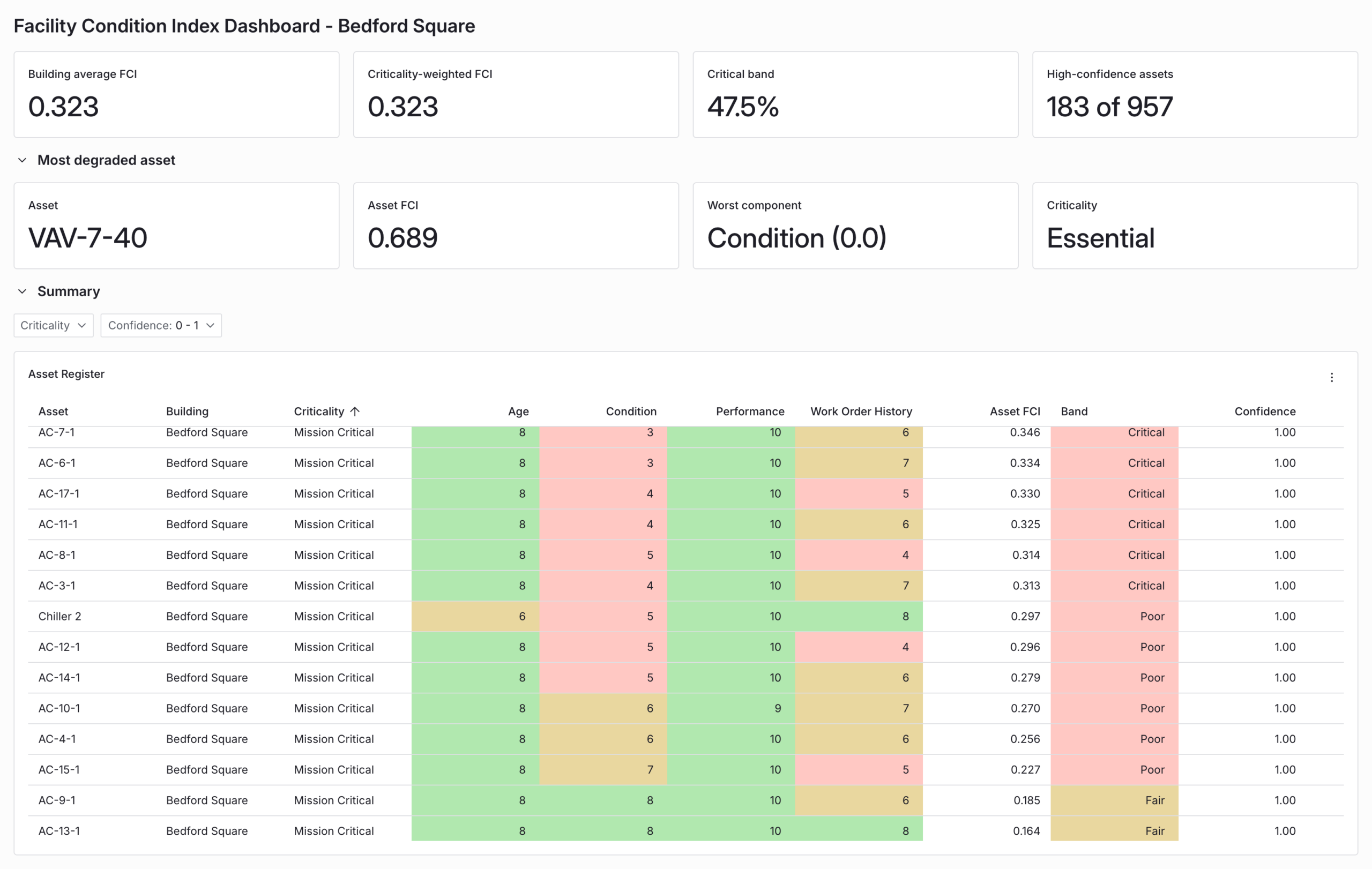
Chronological asset age provides lifecycle context. Willow incorporates manufacturer, model, install date and expected life to compute an Age score that is indicative of when failure becomes more likely.
Traditional condition assessments rely on periodic inspections and subjective labeling. Willow computes a dynamic Condition score. Inspection results, technician assessments, and preventive maintenance all feed into the calculation.
Performance scoring reveals how well an asset is operating. This can be reflected in electrical consumption, actual function vs design capacity and how frequently Insights are generated. Willow incorporates real‑time telemetry and data analytics to understand whether an asset is meeting operational expectations. This dimension can proactively reveal inefficiencies and emerging failures.
Finally, work orders provides a view into how often an asset is reporting failure and requiring technicians to perform corrective or emergency maintenance. Willow analyzes frequency, severity, and root cause patterns to determine the impact on operations. Work Order History can become the dimension that shifts a decision from “repair” to “replace,” because it reveals chronic issues that traditional techniques may not uncover.
By synthesizing these four dimensions, Willow generates a dynamic FCI that reflects the asset’s health and operational state. This enriched FCI score updates continuously as conditions change, giving capital planning teams real‑time visibility into emerging risks and evolving priorities.
The Willow FCI dashboard presents an interactive experience to filter on mission-critical assets and view scores rolled up to a building-level. The same information is also available through Willow Copilot prompts and the Willow MCP Server.
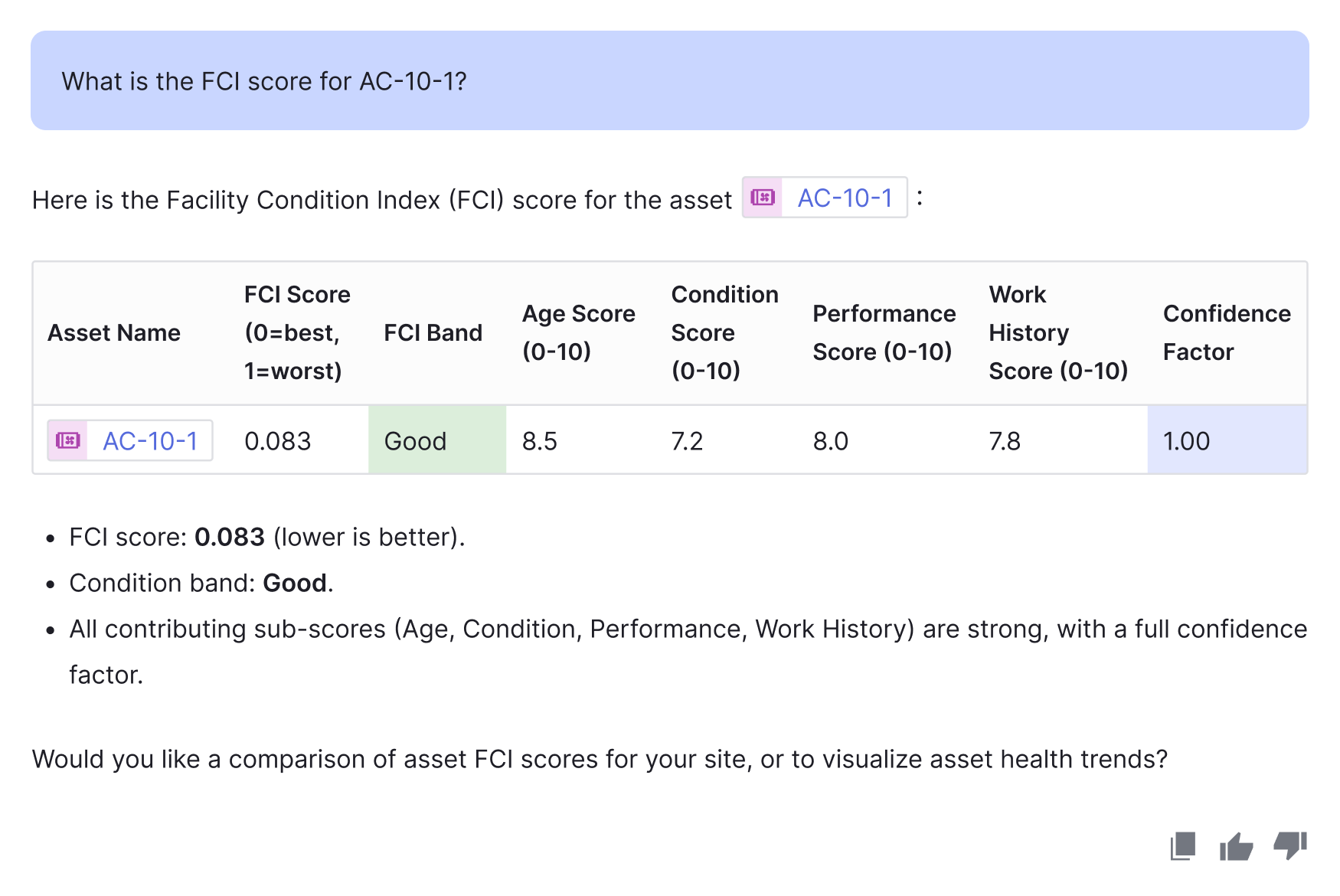
Willow Copilot provides responses to natural language prompts about FCI scores for specific assets, as well as recommendations for actions that the facility team should prioritize. These prompts can be rolled up into Daily Briefings for key stakeholders.
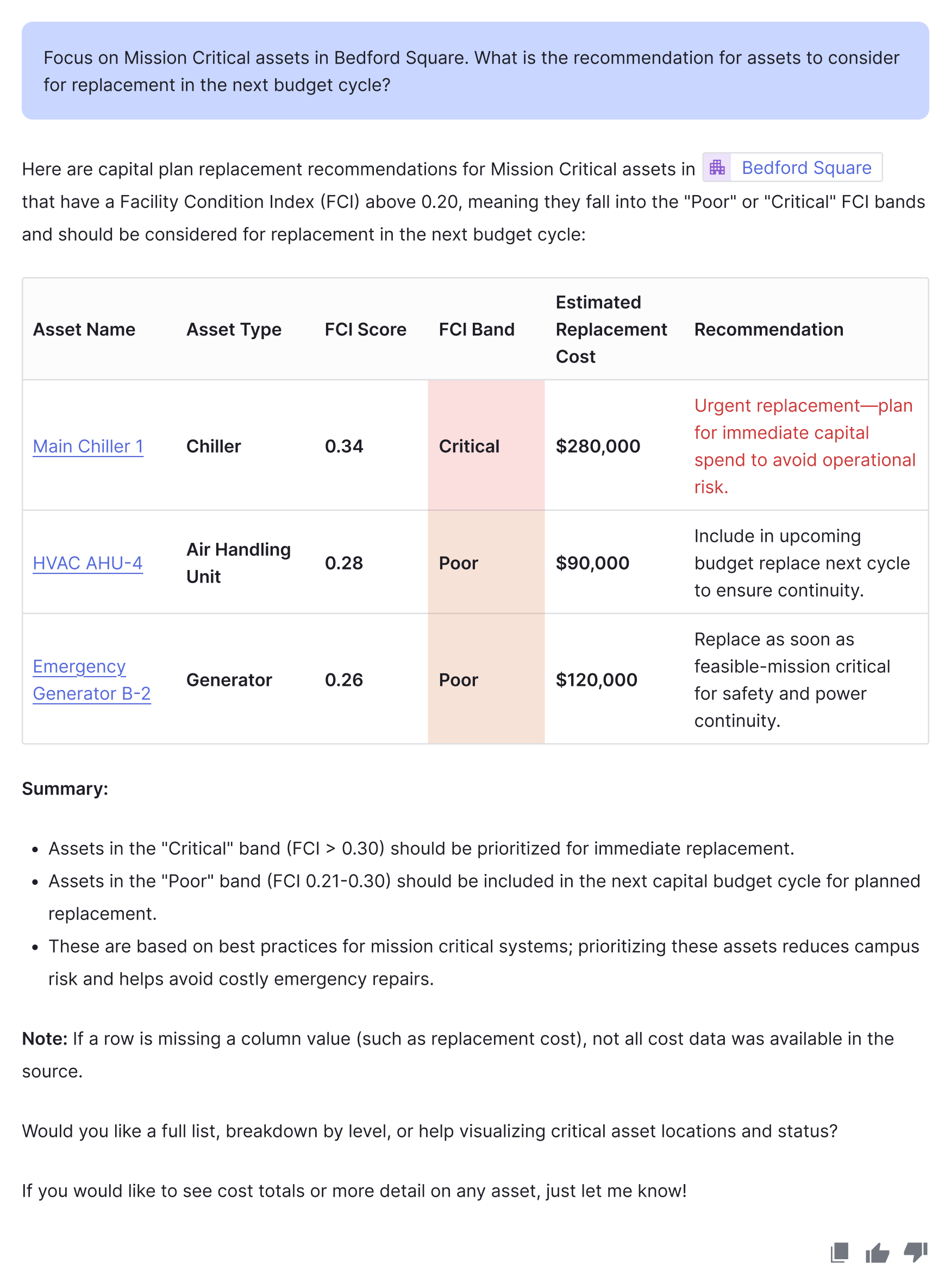
Real-time FCI scores provide a foundation of asset health data that can be analyzed to generate a view of expected repair costs over an upcoming time period. This enables capital planning teams to model scenarios of replacing immediately vs deferring to a later timeframe. Willow provides the evidence capital planning teams need to make informed decisions.
Conclusion
FCI continues to the industry standard metric for asset health, even as building systems are becoming more interconnected and complex, and the stakes for operational resilience and capital efficiency are higher than ever. A static metric presents limitations. Willow transforms FCI into a multidimensional, real-time health score that reflects the current state of assets. By grounding FCI in dimensions reflecting remaining useful life, condition, performance, and failure rate, Willow gives capital planning teams continuous clarity and context into asset health and repair vs replacement costs, without needing to undertake expensive, time-consuming spikes. Decisions become data driven and budgets become defensible, as facilities become more resilient, efficient, and strategically managed.