Inside the Data Layer Behind a Meaningful Data Estate

by Rick Szcodronski, Chief Product Officer, Willow
We are quickly moving towards a world where AI agents help solve the resource and skill constraints facing facility operations while reducing ballooning energy costs. But successfully disrupting the status quo in how facilities in the built environment have been operating for the past few decades starts with a platform that has the proper data foundation. Without this Data Estate for Real Estate in place, platforms are challenged in scalability, accommodating different data configurations, expanding to new use cases, and successfully allowing generative AI to reason over the data. In this blog post, we will explore the data layers that enable Willow’s operational AI platform and contrast them with other approaches. Additionally, we will look at what it means to have an Independent Data Layer (IDL) compared to a consolidated stack.
Data Types
When talking about data, it’s important to clarify what that specifically means since it comes in many shapes and sizes, especially in the real estate industry. At Willow, we have the following types of data which get used to produce the analytical data, such as Insights and Dashboards, and trigger real-time commands:
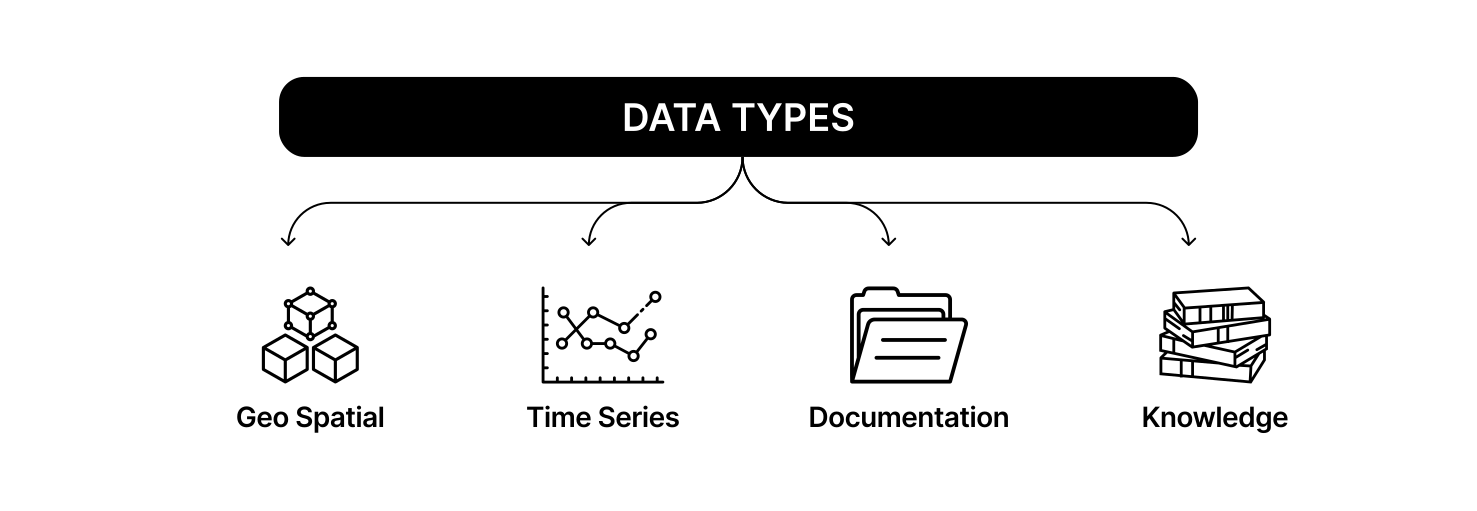
- Knowledge – stored in a graph, information about a building such as its spaces, systems, events, and work being performed
- Documents – artifacts such as owner manuals, warranties, leases, design drawings, or submittals that relate to one or more entities in the knowledge graph such as an asset, a system, or a space
- Time Series – historical or predicted trends which relate to a specific point such as a sensor, setpoint, command, or performance indicator
- Geospatial – the geometry used to visualize a building and its entities such as assets and spaces in 2D or 3D
All four relate to entities within the Knowledge Graph and are instrumental in realizing real-world use cases. This article will specifically focus on the Knowledge Graph. Although there isn’t a focus on the other types of data, they all relate to entities in the knowledge graph and thus remain important in ultimately achieving a use case.
Data Layers in the Knowledge Graph
Willow’s Knowledge Graph consists of the following layers:

Let’s walk through each of these layers, starting with the foundational component of Ontology, followed by Shapes and Data.
Ontology
Ontology is the vocabulary used to describe the real world. It’s a collection of models, each of which contain the properties and relationships that a twin in the graph can have. A model is like a class in object-oriented programming languages where it can inherit from one or more other models.
The real estate industry has a steep history in trying to normalize data entities brought into a platform. Much of that effort has focused on HVAC. We evolved from standard naming schemas to tagging, and now have ontologies.
Willow has a robust real estate ontology, and it’s expanding and evolving every day. As of this writing, Willow’s ontology has over 3,700 models. Within these models, there are definitions for 1,340 properties and 130 relationships. This is about 2-3x more expansive than other ontologies in the market. As a result, Willow is positioned to achieve more use cases and flexibly deploy on unique systems and assets.
Willow’s ontology can describe other systems beyond HVAC. As an example, it can precisely model the complexities of a battery inverter system providing grid demand flexibility. It also models space bookings that are used to dynamically adjust ventilation, weather forecasts for load shedding, and work orders relating to the lifecycle of an asset. Within HVAC, Willow goes much deeper in precisely modeling components and system topologies. For example, understanding the difference between an air-cooled condenser and a water-cooled condenser component of a chiller is critical in running analytics. Willow’s ontology allows defining the design parameters of the condenser for entering and leaving substances like air or water. This enables continuous commissioning, which is important for root cause analysis being surfaced by Willow’s Insights. Speed to value is a core principle at Willow, and our ontology plays a big part in achieving that.
Willow has open-sourced its ontology in an effort to contribute to the industry. You can check it out here.
Shapes
Shapes define what is required and recommended when adding data. While ontology is analogous to vocabulary in a dictionary, shapes are analogous to grammar. This provides a governance on the data which is required to successfully achieve analytics and AI at scale. While not given as much attention as the Ontology and Data layers, it is equally important. We’ll talk more about this when we compare IDLs with a consolidated stack. Many “ontologists” include this Shapes layer within the definition of ontology but they differentiate between the “language ontology” and the “shapes ontology”. Regardless, the meanings of each layer are agreed upon.
Data
In a Knowledge Graph, data is represented as nodes and edges, or twins and relationships in Willow terminology. Each twin references a model, relates to other twins via relationships, and has properties to add further detail. Continuing with the language analogy where the ontology is like vocabulary and shapes are like grammar, data is comparable to the sentences we write.
For decades, the industry has been challenged with extracting “knowledge” from external sources. These include space management, design documents, BMS, and IoT. Organizing at scale given the seemingly infinite configurations, and keeping data updated as buildings and their systems progress through their lifecycles are difficult problems to address. Willow has been hard at work at these issues for many years. This past year, we introduced new breakthroughs in hydrating the graph with even more data using AI onboarding techniques. As a result, this reduces the resources and onboarding time it takes from weeks or even months to hours.
Comparing Data Layer Approaches
How an organization should architect their technology stack is one of the topics consistently talked about across the real estate industry. As technology has evolved, so too has the conversation, but the core question remains: What are the benefits of an IDL compared to point solutions or Willow’s full stack approach? Let’s walk through all three.
Independent Data Layers
The benefits of an IDL are generally summarized as:
- Avoid vendor lock-in for applications serving specific use cases
- Deploy best-in-class solutions on top of the data layer rather than a solution which has many mediocre features
- Consolidate connectivity to source systems to avoid duplicative management and overloading the source
While these are good goals for any organization, I will challenge that these should be more oriented towards specific outcomes. Strong vendor contracts help organizations retain ownership of their data. If they ever change vendors, they can hand over systems in an organized way that supports fast, seamless migration. At the same time, reducing energy use and improving efficiency go hand in hand with better occupant satisfaction.
The questions I would encourage organizations to ask are:
- Is it worth it to avoid vendor lock-in for a solution that has an inferior data layer – ontology, shape, and data?
- Can we mitigate the fear of lock-in by being smart in our contracts?
- If shopping for best-in class solutions is desired, do we really believe they will be plug-n-play to go from one vendor to another or is it sales hype?
The key takeaway here is that cross-team collaboration is a massive challenge in successful adoption of the IDL architecture. There is an immense amount of alignment that different organizations like vendors or standards bodies need to agree upon. This spans across concepts at the ontology and shape layer to proper classification of the data.
Point Solutions
The benefits of deploying point solutions include buying, deploying, and achieving what is needed without any extra fluff, and faster time to value given the focus on individual use cases.
Again, these are good goals for an organization looking to be smart with their spending. The questions I would encourage organizations to ask are:
- At what point are individual vendor use cases, contracts, and management too much to manage and more costly than a single solution?
- Are there additional security risks with opening access to more solutions?
- Will we run into connectivity, consistency, or governance issues if multiple solutions need access to the same sources?
Willow’s Full Stack Approach
At Willow, we’ve taken a full stack approach with a unique solution that builds on the benefits of an IDL and point solutions while removing friction that can slow time-to-value. This offers a best-in-class strategy and vision for any organization.
Willow’s architecture includes Mapped, an industry-leading connectivity and data management platform. Our deep partnership enables customers to achieve value immediately through a consolidated platform, communicating with the source systems. It truly is a “better together” offering with Willow accelerating how quickly customers can activate operational outcomes. What makes the combined Mapped and Willow offering unique and best-in-class? Customers benefit from deep Data layer integrations for ontology, shape, and data. Robust connectivity and alerting are additional advantages. When problems occur with data quality or reliability, our consolidated customer support ensures fast resolution.
For many organizations, a common ontology or traditional tagging is a great place to start. However, the lack of common shapes across vendors makes it nearly impossible to achieve plug-n-play or seamless migration. Through close collaboration, Willow and Mapped identify and address ontology and data shape challenges as they emerge, working to solve the biggest barriers to scaling across the industry. As new connectors are developed and new use cases arise, shapes are created or evolved while still maintaining consistency. This tight engagement allows Willow to evolve rapidly in a matter of days without relying upon a standards body agreement which can take months. Ultimately, this speed-to-outcome approach helps us deliver on our customer promise of fast onboarding.
With Activate Technology, Active Control, and Willow Copilot, we are committed to constantly creating new value streams. Customers can realize use cases quickly across large, global portfolios, well beyond what typical point solutions can achieve. It can be a challenge to translate a strong data foundation into production applications and workflows. Willow pairs an enterprise-grade data layer with ready-to-deploy capabilities that start delivering value within a 30–60 day onboarding period.
Concluding Thoughts
Willow is the leader in Operational AI seeking to disrupt the status quo for how facilities have operated for decades. Buildings running Willow dynamically adapt and respond to their occupants rather than the other way around. Thanks to the incredibly robust data layers, information and knowledge is placed into the hands of operators, energy managers, and owners. This enables data-driven decisions that go way beyond simple fault detection. It’s an exciting time for the industry to realize this vision which has been incubating at the data layer and is now ready to shine.
In a future article, we will look at some real use case examples to understand how value is achieved with the data foundation.